It's been a while and I've been pretty bored so I started on a new project. I'm doing some retro game commentaries on Youtube, just for fun. I'm not really concerned if anybody watches them or not but if you've got nothing better to do why not take a look!
Showing posts with label Video Games. Show all posts
Showing posts with label Video Games. Show all posts
Monday, March 2, 2009

Friday, August 15, 2008
DS Game Review: Bangai-O Spirits
 Last year when I was told this game was coming out I did not believe it. There was no reason for me to believe it after all. Bangai-O was an obscure action title for the Nintendo 64 (in Japan) and the Dreamcast (International release) and the Dreamcast version was the one I had originally played. It doesn't look like a Dreamcast game with tiny little 2-D sprites and fairly mediocre graphics but once the action starts to ramp up you realize why serious hardware is required to play it.
 The game was developed by Treasure, a small privately owned developer in Japan. Ever since one of my favorite games, Gunstar Heroes, Treasure has dedicated themselves to making the games that they want to play, catering to a hardcore video game crowd not just by making difficult arcade style games, but making difficult arcade style games that reak of quality. Their shooter hit Ikaruga has made them synonymous with oldschool style games. Though it wouldn't be fair to say they're trapped in the past as they take old concepts and twist them with new and innovative game mechanics and graphical experiments to create something positively unique.
 Though they often times make licensed games, or even work as a second party to big companies like Sega, Nintendo, and Konami, Treasure has even managed to make excellent games with licenses and under pressure from much larger developers. They're the little team that could, and every once in a while one of their sought after original titles is released. Unfortunately, Treasure games are targetted at a niche audience, so often times they're not produced in high numbers and quickly become rare. In any case I could talk about Treasure for hours, but I'm here today to talk about Bangai-O Spirits.
 Up until about the Gameboy Advance era, Treasure wasn't known for releasing sequels. Their policy was that once a game is finished, it's a complete work, and there's no need for a sequel. This changed a bit as Treasure said if they feel like they can improve upon a game they're revisit it. Though you can argue whether or not they have improved upon past games with their sequels is up for debate, but we'll save that for another time.
Bangai-O didn't seem like an obvious choice for a sequel. It was well recieved but not very widely known. There was room for a sequel with more levels and what not but it was also fine as a stand-alone title. The premise of the game is that you fly around in this little (at least the sprite on the screen) robot and you'd launch either homing missiles or reflective lasers at your enemies. The gimmick was the more danger you put yourself in the more missiles (up to 400!) you could launch when you used your special attack. The sprite-based game could cause so many bullets and explosions to fill the screen that it would even cause the Dreamcast to grind to a hault with slowdown. Some people would say this is a bad thing, but when you're playing a Treasure game you'd feel ripped off without slowdown because it means they weren't trying hard enough. It also helps you adjust to the frantic pace of the game so its mostly intentional. In any case the game was also filled with horrible Engrish which was hilarious and a, well, sort of a story? All that mattered was that the game was ass seeringly difficult yet it was one of the funnest, most addictive, and unique games on the Dreamcast.
 Bangai-O Spirits isn't a direct sequel, but it expands on the original in almost every way. Obviously, you've got more levels and new weapons which make the game a bit deeper and more strategic than the original. The weapons allow you to mix and match like Gunstar Heroes with varying results and melee weapons like the sword and the baseball bat change the dynamic of the gameplay completely. Some weapons are perfect for one level, and completely useless in the next, forcing you to use your head and promoting trial and error. For most games trial and error sounds like a bad thing, but in Bangai-O and Spirits the levels short enough that even if you die for the umpteenth time you don't get frustrated and you usually know what you did wrong which is amazing in a game where most deaths come from being swarmed by bullets. Another interesting thing about Bangai-O is that not all levels are balls-out action, but rather slower paced puzzles, which really helps mix things up and keep it interesting.
 Besides your regular shots which you have a selection of mixing and matching now with the regular homing and bounce shots to the more exotic drill-tipped break bullets or napalm missiles, you can do the same for your special "EX" slowdown-creating-screen-clearing-blast-of-death. Reflect works sort of like the game Giga Wing where instead of launching your own missiles you send the enemy projectiles back at them. There's also an EX move that lets you freeze time for three seconds which doesn't seem like a lot but in this game it's an eternity. Direct is another EX choice, which clumps all your shots together for one devestating forward blast. The game's tutorial references the "Wave Motion Cannon" from Space Battleship Yamato when explaining Direct EX. The EX attack works a little different from the original game. Not only do you have to put yourself in direct danger to make a bigger blast, but also you need to have a few seconds to charge up before releasing in order to get the full potential. Because of the DS's graphical limitations it can't do the 400 missile shots, so instead it makes your missiles larger and larger for the maximum of 100 of the largest missiles that are about three times the size of Bangai-O itself and it's truly a sight of devistation to behold. In the original game you also refilled your EX bar simply by causing explosions, here however the "space fruit" isn't just for points, and you need to collect it in order to refill your EX bar making things a little more challenging.
 Unlike the original game there isn't really a story, which is fine because there really shouldn't be one. The tutorial introduces a few characters and makes some self-referential humor, definitely displaying that they know what kind of gamers they're targetting with this niche game. It's pretty amusing I don't want to spoil it, and there's even an "ending" of sorts after you beat the "Treasure's Best" levels. Speaking of levels, I didn't count, but there's apparently over 160 in the US version which has been tweaked and improved over the Japanese one which is also common for Treasure titles.
I haven't tried to multiplayer yet, but it exists, and the game also comes with a level editor which is Treasure's wat of addressing the original game coming to an end. Interstingly, the game uses a "sound transfer system" and you can save custom levels to your computer by recording the sound, then put them on the Internet for other people to download by playing the sound through headphones over the DS microphone. I have tried this with some custom Japanese levels and it works great. Lots of American levels are popping up on Youtube already and I hope the trend continues so I'll have an excuse to keep playing this game for years to come.
 Treasure has delivered one of the best titles on the DS, though it isn't for everyone. Casual gamers might find themselves scratching their heads at the difficulty, the unique gameplay elements, and non-linearity and lack of any kind of story. Hardcore shooter fans and even puzzle-gamers might find a lot to like about Bangai-O Spirits however. Though it doesn't replace the original game, it makes a lot of adjustments and improvements to the formula that really makes this a must have for fans of the first Bangai-O. At first I griped because it doesn't control the same, using two x/y axis in a sort of Smash TV or Robotron sort of way. Once you get used to it though it becomes second nature and the game gets a bit easier. Once you learn the pros and cons of the various weapons and attacks and the weaknesses of the enemies the difficulty shouldn't scare you away like it would for say, Contra 4, though this game was designed with Treasure's fanbase in mind, so expect to die... a lot... Unlike Contra however the deaths never seem cheap or frustrate from the addicting gameplay.
In any case don't be afraid to try something new and support one of the most dynamic privately owned video game developers in the business. I've been getting reports that this game is difficult to find in stores due to it being a niche title and not being heavily produced, so grab it before it becomes rare! Trust me, if your mind is sharp and and your reflexes are in need of a workout then Bangai-O Spirits will deliver. BANGAI-O! GO!
 Score: 10/10, it's not for everyone but it perfectly achieves what its set out to do and is one of the best, and most unique, games on the DS.
Monday, April 14, 2008
DS Game Review: Front Mission
 Although I got the game Front Mission months ago I finally got around to finally beating it mainly because I've been on one of my giant robot kicks again. I've known about Front Mission for a long time, but it's a series that's remained in Japan for the most part except for the PlayStation installment Front Mission 3 and the PS2 sequel Front Mission 4. I've played neither of those games though I'm no stranger to Japanese turned based strategy games/Turn based RPGs.
I found the original Front Mission for DS surreptitiously as I didn't even know it existed and I wasn't aware at first it was an enhanced port of the original Super Famicom game that for whatever reason (Probably Squaresoft thinking it too hard/complicated for their Western audience, something they did a lot of back then.) Knowing the name and the reputation it has among fans of mecha like myself I bought it for a bargain price that I still don't understand since everywhere I see it today is much more expensive.
In any case let's get to the actual game. Front Mission is a strategy role-playing game, with an emphasis on the strategy part. It reminds me a lot of Battletech in both the oddly Western robot designs and the whole squad based combat angle that the game takes. There are two scenarios you can play in, the beginner's campaign which is the original campaign from the Super Famicom original and the more advanced campaign made specifically for the remake so it's a little shorter. Both tell the same story from different sides of a war that's being fought on a newly formed island in the Pacific in the near future. The story is simple, but full of interesting plot twists as you uncover a military conspiracy. The same events happen in both campaigns, the second campaign referencing the first quite a few times, even having cameos from some of your characters in the first game. It was a neat addition, and I'm sure the Japanese kids who were addicted to this game when it was originally released really got a kick out of it. I did and I've only known the characters for a few months now.
 Besides the leveling up of characters and learning skills aspect the game-play is really bent more towards the strategy aspect. You get over a dozen troops and you can literally spend hours tweaking and customizing your robots or "Wanzers" as Front Mission calls them. Wanzer is short for "Wandrung Panzer" which means "Walking Tank." You can choose which arms, legs, body, a variety of hand held and shoulder mounted weapons, and an energy boosting backpack that makes up your Wanzer. The customization is by far the deepest element of the game, though the combat isn't a walk in the park.
Basically your Wanzers are situated on a pseudo-3D isometric scene separated into a grid. The environments are pretty well drawn, upgraded from the Super Famicom version, and they range from all types of scenes from urban fighting to forests, mountains, deserts, etc. You move your Wanzers around on this grid, and a supply truck that can repair and reload if you have one, and engage the enemy from long, medium, and short ranges. The long range weapons like missiles and medium range weapons like bazookas are essential to success because an enemy can't counter attack when you're attacking them from a distance. The short range weapons like other guns and melee attacks however require you to get up close and personal and unless you destroy the weapon they're attacking with or stun them they'll most likely counter attack you. If you try to do a melee attack and the enemy has a gun however, he'll get the first shot. The damage is randomized and you can destroy an arm, legs, or torso, the latter causing the entire enemy to blow to smithereens if you destroy it. Later in the game you do get the skills to target certain parts and it helps immensely.
 When you attack somebody the view changes, and you get to see your little customized robot kick ass in a nicely animated and more detailed little scene. Every part has its own sprite which makes the customization even more interesting. My only complaint about combat is just how broken long range attacks are. You're limited on missile ammo but they're usually rather powerful and they don't require you to put your units in danger. There's also items like chaff that throw off missiles but for the most part missiles are insane and I've won entire missions with long range barrages alone. They don't completely break the game though, and I really enjoyed the simple combat as well as buying new weapons to see what they do.
I also need to stress the length of this game. If you go through both campaigns you're looking at easily over 60+ hours of game-play especially if you're obsessive compulsive about customizing your Wanzers like I was. This game is best in small doses though, I really don't recommend anybody sit down and go through several missions at once because you really need a break after some intense tinkering with parts and fighting for your life in a mission only to be presented with a whole new collection of parts.
I can't really recommend this game to everyone because you need to devote a lot of time and effort into it to really get the most out of it. If you do give it a chance though you're in for a lot of the old Squaresoft magic with an intelligent story, inexplicably fun game-play, and lots and lots of robots beating the crap out of each other. I don't know why Squaresoft didn't release this on the Super Nintendo but I think it would have been a classic in the West if they had. As it stands now the game is a bit dated, but that shouldn't be a problem for anyone who enjoys old-school graphical style as it's certainly not ugly just dated compared to what the DS is capable of. There are some sweet CGI cut-scenes in the second campaign at the very least. It's a game that I feel like I missed out on that I'm glad the Nintendo DS let me experience.
8 out of 10
Tuesday, January 22, 2008
Faux News: Video Game Sex
I think this video pretty much speaks for itself. Fox News shows again and again why it's a bad idea to have a news source that fails to be objective. Everything about this "report" or "debate" or whatever you want to call it is misinformation charged with group think and school yard bullying. They invite one person who actually knows what's going on and do nothing but bash him and not let him get a word in.
I don't even really care about the game in question, Mass Effect, but it's the way that Fox News handles itself while pretending to be a serious news network that makes my blood boil. First of all Mass Effect's sex scenes are hardly the "full frontal nudity" that Fox News would like everyone to believe it is. They act like the game, which is a sci-fi space opera role-playing game revolves around the sex while most players will get through the game without even running into it.
There are a few things that really jump out at me with this video. The first is that they really never even consider opinions that are against their own. None of them have played the game or even understand video games (Mass Effect never objectifies women and in fact you can play as one). They believe that the video game market is still solely dominated by adolescent males which is untrue as more females are getting into video games and other generations, like mine for instance, who grew up with them are still playing them. They completely ignore the child-lock out feature of the X-Box 360 which will prevent children from playing mature rated games, and they also ignore the ESRB ratings completely. Why is it that we let rated R movies get away with horrible depraved things but when a video game has a M rating, one which means nobody under 17 should be playing, all of a sudden that rating doesn't mean anything?
The most cutting line comes at the end when there's a halfway intelligent comment about how at the end of the day it's the parent's responsibility to prevent their children from playing games that will be harmful for them, which is answered with, "Unfortunately." So there you go. Conservatives have admitted on live TV to being bad, lazy parents.
God forbid if these people ever found out what would happen if their children typed the word "tits" into Goolge Image Search.
Monday, January 7, 2008
NES Classics Volume 1: The Super Mario Bros. Trilogy
 So now that my Generation NEX is here, and I've got to tell you this beauty is leaps and bounds over the Yobo FC Game Console in both style and game compatibility, I've decided it's time to start talking about a few NES games. To get things started, instead of discussing one game, why not talk about the system's three star titles. That's right, the portly princess saving plumber and his 8-bit trilogy of Super Mario Bros. I won't review these per-se because of nostalgia goggles, and despite the fact that all I'm about to say has been said before, I'd like to talk a little about each game in the series that both Nintendo and Mario household names.
 Super Mario Bros.
In the video game industry there's a lot of arguing over which games are the best examples of certain genres or which games are the most important or influential. One thing you won't hear argued is that Super Mario Bros. is simultaneously one of the greatest games and the most influential game ever created.
Super Mario Bros. was probably the first example of a modern video game that was designed to be fun instead of eating quarters or frustrating the player. The controls were finely tweaked (very few NES games managed to duplicate the sublime play control of the Super Mario games) and there was a sense of purpose to what you were doing. The gameplay was deceptively simplistic at first: jump on your enemies and get to the end of the level. Surprisingly, controlling Mario turned out to be inexplicably fun and the more you explored the deeper the game became. That simple "save the princess" plot meant a lot back in the day, because unlike most games at the time there was a goal, an ending, you could actually beat it instead of being faced with a "game over" screen.
The enemies were all recognizable instead of just random jumbles of pixels. Just about everyone knows what a Koopa or a Goomba is. How many video games have had minor enemies that have become that well known? The power ups were another new concept that gave the player something to work for. The difficulty is a near perfect balance and the game can be beaten simply with enough practice. Secrets scattered throughout the game kept people playing to try new things and get through levels in different ways. To this day I can still return to the game and have fun playing it despite the fact that I've beaten it more times than I care to remember and I've been playing it since before I was sapient.
Though they don't look like much today the graphics were also a huge leap over what we were used to seeing. It was amazing at the time to look at something in a video game and immediately know what it is. I haven't even mentioned the simple music which is still catchy and recognizable today, perfectly designed to keep looping without the player getting annoyed with it.
Super Mario Bros. inspired countless sequels and spin offs, thousands of clones, and did several things for the first time that video games are still doing today. It brought video gaming back from the dead after the crash in 1984 while completely changing the way we looked at and played video games, starting a trend that would make them a part of our every day lives. Hats off to you, Super Mario Bros. You are truly a work of genius.
 Super Mario Bros. 2
Super Mario Bros. 2 is the black sheep of the trilogy, like any trilogy be it video games or movies there's always the awkward one that's love it or hate it. There's a damn good reason for this in the case of Mario 2 as just about everyone who's ever played a Mario game already knows, Mario 2 was not the "original" Super Mario Bros. 2 though its place in the Mario canon has become solidified as the official one.
The original Super Mario Bros. 2 is what America received on the SNES Super Mario All Stars compilation as The Lost Levels though it can now be obtained in its NES form for the first time ever in the Western world via the Wii Virtual Console. The Lost Levels or rather the Japanese Mario 2 uses the same basic graphics with a few tweaks to the sprites from the first game. The major difference to Mario 1 is that it amps up the difficulty to an insane degree. Rumors say that we didn't receive that game because it was either "too difficult" for Western gamers or it was "too similar" to the first game and it would've disappointed fans who were seeing the NES pulling off more and more impressive tricks. Don't get me wrong, despite it's difficulty it's a great game, and in reality the 8-bit story of Super Mario is a quadrilogy instead of a trilogy.
The Super Mario Bros. 2 that we got started as a Nintendo platformer called Doki Doki Panic. Everyone's heard the story by now so let me cut it short by just saying Nintendo swapped out the sprites and gameplay elements for Mario ones, tweaked and improved the gameplay, and slapped the Super Mario Bros. name on it. This lazy move was completely unnoticed by NES owners who welcomed the sequel to one of the greatest games ever with open arms. Rumors about the original Super Mario Bros. 2 surfaced as a playground legend until it landed on Western shores for the SNES. It's amazing when you think about it because with the Internet today you'd never be able to get away with something like this now.
The first thing you noticed about the game was it's graphics. They're a major face lift over the original and I'm certain that's one of the reasons Nintendo chose to remake Doki Doki Panic in Mario's image. The second thing you'll notice is you have a choice of four characters, the brothers of Mario and Luigi of course, Toad of the mushroom people, and even the Princess herself. They all have different jumping abilities (Mario is the same as always, Luigi flails his legs to stay in the air longer, Toad can't jump worth shit, and the Princess is the most unbalanced character in the game because she can float for a short period of time) and different levels of strength (how fast they can pick things up).
When you get into the game, jumping on the enemies doesn't kill them, it doesn't even phase them, they'll just keep right on walking. You have to pick them up and throw them at other enemies to kill them. You can also pull radishes and other weapons from the ground to chuck at your opponents. All of Mario's familiar enemies are gone in this game, replaced by Doki Doki Panic's cast of baddies and instead of power ups you find mushrooms behind doors that you create with some kind of potion (don't ask me) that add to your life bar, another first in the Mario series. When you're down to one life you shrink like in other Mario games, though unlike in other Mario games being small is just a graphical thing and has no distinct advantage.
Honestly I missed the familiar foes and gameplay elements and when I was little this game confused me a bit because it's certainly not a Mario game. Still, Nintendo told me it was, and at the time I believed them. It's certainly not a bad game, though one wonders if it would've been popular if it was released in its original form and not as a Mario game. Since we never got the original Mario 2 on the NES, or the unaltered Doki Doki Panic while Japan got our Mario 2 as Super Mario USA I feel kind of ripped off. Despite all its weirdness (which is explained in the game's ending as Mario wakes up from a dream), this game gave us something new and kept the franchise rolling to its next, biggest, and brightest achievement.
 Super Mario Bros. 3
While Mario 2 kept held us over, most of us preferred the original formula, and there were a lot of mixed feelings about the game. Nintendo was busy taking that original formula and fermenting it, making it stronger, bigger, and better. The result was Super Mario Bros. 3, and despite being an 8-bit game many video game aficionados still consider this to be the greatest title in the franchise, if not one of the greatest video games ever made.
Mario fans were back to jumping on familiar bad guys, meeting a few new ones, and collecting new power ups. And my god were their a lot of power ups. After the old-school fire flower there was the leaf that for some reason gave you racoon ears and a tail and allowed you to whip enemies and fly. The immense variety of different suits and other new goodies to play with gave the series more depth than ever before. The gameplay retained it's simplicity, but there was just so much to do and so many well hidden secrets to uncover that you could waste months finding it all.
The game introduced us to the concept of a world map that we'd see in future games in the series, it added mini-games to collect lives and power ups, it even let Mario and Luigi duke it out in a the battle arena from the original Mario Bros. arcade game. The levels were once again perfectly balanced, where as both of the Mario 2's difficulties were a bit menacing and not quite as fair. Anyone could play this game and have fun and with practice they could beat it.
I still remember the gossip circulating about where to find the warp whistles that allowed you to skip levels and the ability to don the Hammer Brother's suit and wield the power of one of Mario's most fearsome enemies. Yes, the time before the Internet was certainly a magical place filled with mystery and intrigue. There's just so much in this game that surprises you like the world where everything is gigantic or the slippery ice world. Every new world is unique and full of surprises, all with the same inexplicable addictive fun that the original game had. If I had to choose one game to be stranded on a desert island with, this would be the game, since somehow Nintendo cracked the secret formula for infinite replay value when they made this game.
I don't know what else to say, it's hard to describe exactly how perfect and polished this game is. Nintendo took everything that was good about Mario up until this point and magnified it by a thousand fold. Some people believe that Super Mario World for the SNES is the definitive title in the franchise, but the fact that many more people, including myself, consider 3 to be the best, as well as one of, if not the greatest platform game ever made is testament to how incredible the game is considering it's built on vastly inferior technology. Nintendo knew the NES inside and out when they made Mario 3 and they squeezed everything they could out of it. They made music and graphics that should've been impossible to make and paired it up with that classic, perfectly balanced Mario gameplay.
Super Mario Bros. 3 ended the 8-bit era for Mario, though it paved the way for many more classics to come. It proved that lightning could strike twice and helped solidify Nintendo as a major force in the video game industry.
Conclusion
There's not much else to say. The NES trilogy of Mario games will probably fade from memory as kids grow up on more modern video game systems, but it's indisputable that the currently growing industry owes a lot to these three games. I might sound a little too glowing here, and I'm even a Sega Genesis obsessive so it's not a love for Nintendo that guides these ravings. With New Super Mario Bros. on the Nintendo DS the old Mario formula keeps on trucking without showing its age, and I can still play through the old games without getting bored. These games are truly timeless and stand for everything that video gaming is today. Other games may have come before this franchise, and more impressive games may have come after it, but none of them innovated like it.
Saturday, December 29, 2007
Post-Christmas DS Games
So after getting The Legend of Zelda: Phantom Hourglass for Christmas and two additional DS games with Christmas money I've been a little distracted lately. I thought I'd write some quick reviews of some of this holiday season's best portable offerings. The DS is one of my favorite video game platforms to come along in a very long time. It's affordable and intuitive and full of that often quoted Nintendo "innovation."
The Legend of Zelda: Phantom Hourglass
 Like most Nintendo franchises Zelda and I have a pretty good relationship. I'm not a hardcore fan, and I've always preferred the sci-fi styling and open-ended nature of the Metroid series, but you have to recognize the brilliance that keeps Zelda one of the most cherished and longest running video game franchises out there.
Recent Zelda games have fallen into two camps. The serious, more realistic looking Zelda that started with N64's Ocarina of Time, and the stylized cartoon-ish Zelda that started with the Gamecube title Wind Waker which hearkens back to the days of simpler graphics. Phantom Hourglass is part of the latter bunch and it fits the portable nature of the DS just fine.
The game is controlled entirely by touch-screen which made a few people cringe at first but it works so well and offers so many innovative game-play elements that it nearly makes my head explode. Nintendo wanted to make an example to other developers with this game and they use every inch of the DS from the touch screen to the microphone, they even have one puzzle that's solved by closing the system. The game was designed by a few of the people who worked on the SNES classic A Link to the Past and it certainly shows. It's a brilliant meld of both classic and modern Zelda, feeling like an old-school game but with imaginative new puzzles and ways of using old tools via the touch screen.
Memorable characters like the greedy and cowardly Linebeck and your over-eager fairy companion Celia don't hurt either. It's got a cute and funny story that doesn't take itself too seriously which helps break up the monotony between puzzles, and just about every part of this game is an intricate puzzle. Like most Zelda games it's chalked full of side-quests and secrets that will probably drag me back to playing it eventually. My only complaint is forcing you to revisit the starting temple several times and making you play it on a timer which was at times difficult and frustrating.
Still, this is by far the best hand-held game of the year and proof that the franchise isn't dead yet.
10 out of 10
Call of Duty 4: Modern Warfare
 When I first saw this, like a lot of people I laughed out loud. Call of Duty 4 for PC/PS3/X-Box 360 has been widely heralded as 2007's game of the year, and for good reason. The graphics are some of the best in any video game, ever. But the disturbing amount of realism doesn't end with how the game looks, but the voice acting, the way the guns function, the iron-sights, the artificial intelligence, the brilliant story and gut-twisting scripted sequences... all of this makes the game one of the greatest, most realistic war operas ever created. It doesn't leave you with a sense of glorifying war or violence, it leaves you with the shaken feeling that war is hell and something nobody should ever have to participate in. Call of Duty is a franchise that's been known for it's incredible WWII themed games and the fourth installment in a modern day setting with terrorists and crazed Russian nationals has been the kick in the pants that it really needed to put it over the top. Maybe it's because of the times we live in that make the game more topical and significant, but it certainly makes you feel like you're there with intense action while it rips out your heart and stomps on it with the grim reality of war.
The DS version doesn't quite have all that, but one thing is for certain, they made sure that they would strive for quality with the hand-held version and saw that it lived up to the Call of Duty name. All the intense action is there. The levels look good for the DS. The guns have their iron-sights. The scripted sequences are amazingly animated on such a tiny screen and really shocked and surprised me the first time through.
Instead of trying to replicate the entire experience of its big brother game it plays as sort of a side-story to the other versions of the game. You play as anonymous Marines and British SAS members that go on different supporting missions during the little secret war that you're fighting in. They managed to keep in little tidbits like the support missions where you're gunning off the top of a truck or in a helicopter, and they even managed to put in the high altitude level where you're the gunner in an AC-130, looking through a black and white radar scope and raining death from above to support your troops who are running around on the ground completing objectives. The variety keeps the game interesting and keeps you immersed the whole way through. The game also has a beautiful orchestral score and like its big brother, a load of voice acting with troops barking out orders and adding to the hectic action.
The AI isn't quite as advanced as the bigger brother version. Guys will still run out, duck behind objects, and toss grenades, they'll even pick them up and toss them back (you can toss them back too naturally, and you've also got flashbangs). For the most part though they'll just stand there and let you shoot at them. The hit detection is pretty good. If you shoot at the chest of your enemies you'll just be wasting bullets on their body armor, but a pop or two to the head will take them right down. Unlike the other versions of the game your allies are also dumb as shit, and except for a few rare occasions just stand around being useless.
The game was also criminally short and has no Wi-Fi online play, though it does have local multi-player which I'm looking forward to trying. I probably would've gotten bored if it were any longer though. As it stands the game shows just how well first-person shooters can be handled on the DS.
8 out of 10
Contra 4
 In the history of video games, few titles evoke more swearing and admiration than the Contra series. This year is Contra's 20th anniversary and in celebration of that landmark, Konami has decided to give a little gift to its loyal fans. I've never personally been the biggest fan of the series but this is an important game and something that many people would've never thought possible in today's world of simple games designed so that anybody can beat them and move on with their lives. The appeal of Contra is you're going to have to have weeks, months, even years of practice until you memorize the levels master the delicate controls necessary to guide your one-hit-and-dead soldier through the perils of the Contra world.
Another reason this game is so important is because it's a direct follow-up to the SNES classic Contra 3: Alien Wars and it's the first traditional 2D contra game since the absolutely insane and absurdly hard Contra: Hard Corps on the Sega Genesis. This isn't surprising because the series isn't terribly popular in Japan and since I don't see too many muscular, American, machine-gun toting commandos staring in anime I don't have to ask why this is. In the West, Contra is viewed almost as a right of passage for the "hardcore" gamer, revered for its toughness and unforgiving level design. The bosses are brutal and insane and just about every moment of this game will have you screaming "You've gotta be kidding me, this is fucking impossible." Konami had an American team design the game and despite being only the second Contra to not come from Japan, the result is fantastic. The game looks great, the game-play is polished to a crystal shine, and the balance and level design is as perfect as Contra has ever gotten.
It's loaded with extra unlockable content including a challenge mode, a Contra museum that pays homage to the previous games, and even emulated versions of the original NES classics, Contra and Super-C. I don't often say this about modern games (with the possible, but not certain exception of Metroid Prime) but Contra 4 is the probably the best Contra game ever made. It may be designed for a niche audience but it's nice to see something like this can still be made in 2007. This is the only game on my list today that I haven't beaten yet and it'll probably be a long, long time until I do and that's what Contra is all about.
9 out of 10
The Legend of Zelda: Phantom Hourglass
 Like most Nintendo franchises Zelda and I have a pretty good relationship. I'm not a hardcore fan, and I've always preferred the sci-fi styling and open-ended nature of the Metroid series, but you have to recognize the brilliance that keeps Zelda one of the most cherished and longest running video game franchises out there.
Recent Zelda games have fallen into two camps. The serious, more realistic looking Zelda that started with N64's Ocarina of Time, and the stylized cartoon-ish Zelda that started with the Gamecube title Wind Waker which hearkens back to the days of simpler graphics. Phantom Hourglass is part of the latter bunch and it fits the portable nature of the DS just fine.
The game is controlled entirely by touch-screen which made a few people cringe at first but it works so well and offers so many innovative game-play elements that it nearly makes my head explode. Nintendo wanted to make an example to other developers with this game and they use every inch of the DS from the touch screen to the microphone, they even have one puzzle that's solved by closing the system. The game was designed by a few of the people who worked on the SNES classic A Link to the Past and it certainly shows. It's a brilliant meld of both classic and modern Zelda, feeling like an old-school game but with imaginative new puzzles and ways of using old tools via the touch screen.
Memorable characters like the greedy and cowardly Linebeck and your over-eager fairy companion Celia don't hurt either. It's got a cute and funny story that doesn't take itself too seriously which helps break up the monotony between puzzles, and just about every part of this game is an intricate puzzle. Like most Zelda games it's chalked full of side-quests and secrets that will probably drag me back to playing it eventually. My only complaint is forcing you to revisit the starting temple several times and making you play it on a timer which was at times difficult and frustrating.
Still, this is by far the best hand-held game of the year and proof that the franchise isn't dead yet.
10 out of 10
Call of Duty 4: Modern Warfare
 When I first saw this, like a lot of people I laughed out loud. Call of Duty 4 for PC/PS3/X-Box 360 has been widely heralded as 2007's game of the year, and for good reason. The graphics are some of the best in any video game, ever. But the disturbing amount of realism doesn't end with how the game looks, but the voice acting, the way the guns function, the iron-sights, the artificial intelligence, the brilliant story and gut-twisting scripted sequences... all of this makes the game one of the greatest, most realistic war operas ever created. It doesn't leave you with a sense of glorifying war or violence, it leaves you with the shaken feeling that war is hell and something nobody should ever have to participate in. Call of Duty is a franchise that's been known for it's incredible WWII themed games and the fourth installment in a modern day setting with terrorists and crazed Russian nationals has been the kick in the pants that it really needed to put it over the top. Maybe it's because of the times we live in that make the game more topical and significant, but it certainly makes you feel like you're there with intense action while it rips out your heart and stomps on it with the grim reality of war.
The DS version doesn't quite have all that, but one thing is for certain, they made sure that they would strive for quality with the hand-held version and saw that it lived up to the Call of Duty name. All the intense action is there. The levels look good for the DS. The guns have their iron-sights. The scripted sequences are amazingly animated on such a tiny screen and really shocked and surprised me the first time through.
Instead of trying to replicate the entire experience of its big brother game it plays as sort of a side-story to the other versions of the game. You play as anonymous Marines and British SAS members that go on different supporting missions during the little secret war that you're fighting in. They managed to keep in little tidbits like the support missions where you're gunning off the top of a truck or in a helicopter, and they even managed to put in the high altitude level where you're the gunner in an AC-130, looking through a black and white radar scope and raining death from above to support your troops who are running around on the ground completing objectives. The variety keeps the game interesting and keeps you immersed the whole way through. The game also has a beautiful orchestral score and like its big brother, a load of voice acting with troops barking out orders and adding to the hectic action.
The AI isn't quite as advanced as the bigger brother version. Guys will still run out, duck behind objects, and toss grenades, they'll even pick them up and toss them back (you can toss them back too naturally, and you've also got flashbangs). For the most part though they'll just stand there and let you shoot at them. The hit detection is pretty good. If you shoot at the chest of your enemies you'll just be wasting bullets on their body armor, but a pop or two to the head will take them right down. Unlike the other versions of the game your allies are also dumb as shit, and except for a few rare occasions just stand around being useless.
The game was also criminally short and has no Wi-Fi online play, though it does have local multi-player which I'm looking forward to trying. I probably would've gotten bored if it were any longer though. As it stands the game shows just how well first-person shooters can be handled on the DS.
8 out of 10
Contra 4
 In the history of video games, few titles evoke more swearing and admiration than the Contra series. This year is Contra's 20th anniversary and in celebration of that landmark, Konami has decided to give a little gift to its loyal fans. I've never personally been the biggest fan of the series but this is an important game and something that many people would've never thought possible in today's world of simple games designed so that anybody can beat them and move on with their lives. The appeal of Contra is you're going to have to have weeks, months, even years of practice until you memorize the levels master the delicate controls necessary to guide your one-hit-and-dead soldier through the perils of the Contra world.
Another reason this game is so important is because it's a direct follow-up to the SNES classic Contra 3: Alien Wars and it's the first traditional 2D contra game since the absolutely insane and absurdly hard Contra: Hard Corps on the Sega Genesis. This isn't surprising because the series isn't terribly popular in Japan and since I don't see too many muscular, American, machine-gun toting commandos staring in anime I don't have to ask why this is. In the West, Contra is viewed almost as a right of passage for the "hardcore" gamer, revered for its toughness and unforgiving level design. The bosses are brutal and insane and just about every moment of this game will have you screaming "You've gotta be kidding me, this is fucking impossible." Konami had an American team design the game and despite being only the second Contra to not come from Japan, the result is fantastic. The game looks great, the game-play is polished to a crystal shine, and the balance and level design is as perfect as Contra has ever gotten.
It's loaded with extra unlockable content including a challenge mode, a Contra museum that pays homage to the previous games, and even emulated versions of the original NES classics, Contra and Super-C. I don't often say this about modern games (with the possible, but not certain exception of Metroid Prime) but Contra 4 is the probably the best Contra game ever made. It may be designed for a niche audience but it's nice to see something like this can still be made in 2007. This is the only game on my list today that I haven't beaten yet and it'll probably be a long, long time until I do and that's what Contra is all about.
9 out of 10
Tuesday, October 30, 2007
A New Toy: Yobo's FC Game Console
 So a friend of mine just bought an old Nintendo Entertainment System (NES) last week off of eBay and I helped him replace the old, bent up 72 pin cartridge connector. It works like a dream now and to be honest I really got kind of sentimental about my old gray brick that I sold off for fifteen bucks a few years back when I was still in high-school like the moron that I am.
Anyway we were out looking for games at a local store that still carries old cartridges from trade-ins and for that same fifteen bucks sat the "Yobo FC Game Console," a popular Nintendo clone that's sold legitimately in the US ever since Nintendo's hardware patents ran out. I instantly had to be a copy-cat and buy up some games for myself, but unlike my reckless Sega Genesis collecting I promise to keep myself in check (As if I need something else to distract me). I'm only going for the honest to goodness classics or games that I personally have nostalgia for. In any case this little silver Yobo box has been a good jump start back into the land of NES games for me. I was just impressing some freshmen with my Super Mario Bros. skills, one of which had never played the game in his life, and goddammit do I feel old now.
In any case let's talk about the FC Game Console or as we've been affectionately calling it: the Yobo. Originally it was a Famiclone called the NeoFami (the name of the NES in Japan is the Family Computer or Famicom). A third party hardware company called Yobo decided to import the little box, roughly the size and height of two NES games, to the US with a 72 pin cartridge connector for US games and they were even nice enough to use Nintendo's proprietary NES controller ports so that you can use real honest to goodness Nintendo controllers. As you can see in the picture I got myself an old NES pad and a zapper that both work perfectly fine with the Yobo. We also tried out an NES Advantage arcade stick without any trouble. The two controllers the Yobo comes with are actually pretty nice and really comfortable with what's essentially a SNES style layout. They feature both slowdown and turbo functions which are also appreciated though like the Yobo itself they feel flimsy and shoddily constructed. Though I like the Yobo's sleek and minimalistic look (and the blue LED on the power button is a nice touch) there's always the fear of it breaking due to its cheap build.
The Yobo's game playing isn't perfect. The good thing is games will usually start up after only one or two tries which is nearly impossible with an original Nintendo (though those replacement pins have done wonder's for my friend's eBay trophy). The Yobo is built on an NOAC or NES-on-a-chip which means most of the functions that the hardware of the NES was responsible for are now being done on a single tiny chip. The problem with this is that in some games the sound will be off or the colors will not match perfectly with the original. This is only a minor complaint as I haven't had any serious problems so far. The only major games that the system is completely incompatible with are Castlevania III and Gauntlet and I can live without them (especially because Gauntlet II will work). I haven't run into any serious graphical glitches in other games though the system is prone to a bit more slow-down than a real NES, also not a problem for me. I might talk about some particular games at a later date. As you can see in the picture I snagged a copy of the marginally rare yellow-label Metroid that works like a dream in the Yobo.
Like I said, the Yobo is only a start. Though I don't feel like getting a legitimate NES again any time soon I'm thinking of grabbing a Generation NEX for Christmas. I've read it has many of the same problems as the Yobo but it's a much slicker, more legitimate looking device that also plays Famicom games (Which means I can pick up that fun little Macross shooter). This comparison by Run! Jump! Shoot! also recommends it as a good replacement model for the original though at $60 I'd much rather buy a Yobo. But hey, if we're talking Christmas gift then why not. If you want to get in on NES collecting and you're on a budget I can't recommend the Yobo enough. It's basic, it's got wonderful AV output that's probably better than that of the original NES, it works with all NES peripherals and most of all it's cheap.
Saturday, August 25, 2007
Genesis Does!
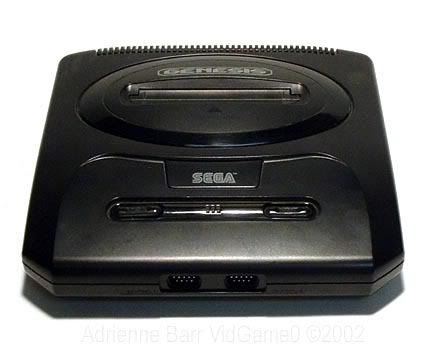
Time to introduce you to another slightly embarrassing hobby of mine. Or maybe not, as I'm not as extreme as certain collectors out there. For some reason I started collecting all things Sega Genesis. I mean everybody's got a collection of something, why not Genesis games? It was cheap, fun, and I love the system to death. If you're part of my generation and you played video games you fell into one of three categories: You had a Sega Genesis, you had a Super Nintendo, or you were a spoiled rich kid and you had both. I, as you might have guessed, was one of the kids with a Genesis.
I'm not entirely sure why I hold this particular system in the highest regard in terms of nostalgia, I mean I had an Atari 2600 and a Nintendo Entertainment System well before I graduated to the mighty Mega Drive. I guess when I got my hands on the Genesis in the 4th grade I was just at the age where I was old enough to start really understanding video games. Then again my favorite system after the Genesis just so happens to be the Dreamcast, so maybe I'm just a Sega fanboy in denial.
Interestingly enough I've noticed a divide among gamers my age. The majority of those who had the Genesis are more into action oriented, arcade style games. Those with the Super Nintendo are more satisfied by adventure games and RPGs. This isn't really shocking considering those were the strong suits of their particular systems. You couldn't get the Genesis speed out of a Super Nintendo or the Super Nintendo graphics and sound out of a Genesis. There are of course exceptions and arguments for and against everything I just said but that's okay... let's continue.
Over the years I've collected 87 Genesis and 32X (an ill fated add on designed to deliver better graphics and sound) games and a bunch of peripherals. Some I'm proud of (Gunstar Heroes) and others... not so much (Batman Forever). My original intention was to collect all of the games I used to rent when I was younger and for the most part I've succeeded. I'm missing a few but a large chunk of my childhood has been safely purchased. The Genesis isn't the only system I collect for but it's been my main focus if only because it means the most to me. Also, let's not kid ourselves; it's the least expensive.
It seems strange, since I can just download the entire ROM collection for the Genesis and probably safely fit it onto one DVD but there's just something about having those little black carts and in some cases, their plastic clamshell boxes. I'm not that anal about collecting the boxes which raise their value since I don't aim to sell the games any time soon, however they are nice to have. It's a shame some great games like Vectorman were cursed with the late model paper boxes that don't look as good or hold up as well.
I also learned that collecting is a nice way to get involved in online communities (like Ken Horowitz's awesome Sega-16). It's fun to meet others and discuss what's good, what's terrible, what's rare, and what's so common you can find ten copies of it in your dumpster out back. I really like talking with people who share a common interest in something I enjoy and sometimes they can even help me find that stubborn piece of my collection I've been looking for. I found the act of collecting to be almost as exciting as the games themselves, if only for the old memories and the new friends.
Unfortunately, or maybe fortunately for my savings account, I've slowed down my collecting in the past few months. I've gotten almost everything I want except for a few pieces that are so rare and expensive I doubt I'll ever manage to get my hands on them, I have my limits (here's looking at you M.U.S.H.A.). I'd recommend to anyone out there who's bored to try starting a collection of something they enjoy, it's a really rewarding experience.
I'll be keeping my eye open for the missing pieces of my collection. Just remember if you ever see a creepy guy filing through those archaic black cartridges in the back of your game store instead of swooning over the newest incarnation of Halo, it just might be me.
Subscribe to:
Posts (Atom)